Democratic Republic of Congo (DRC)
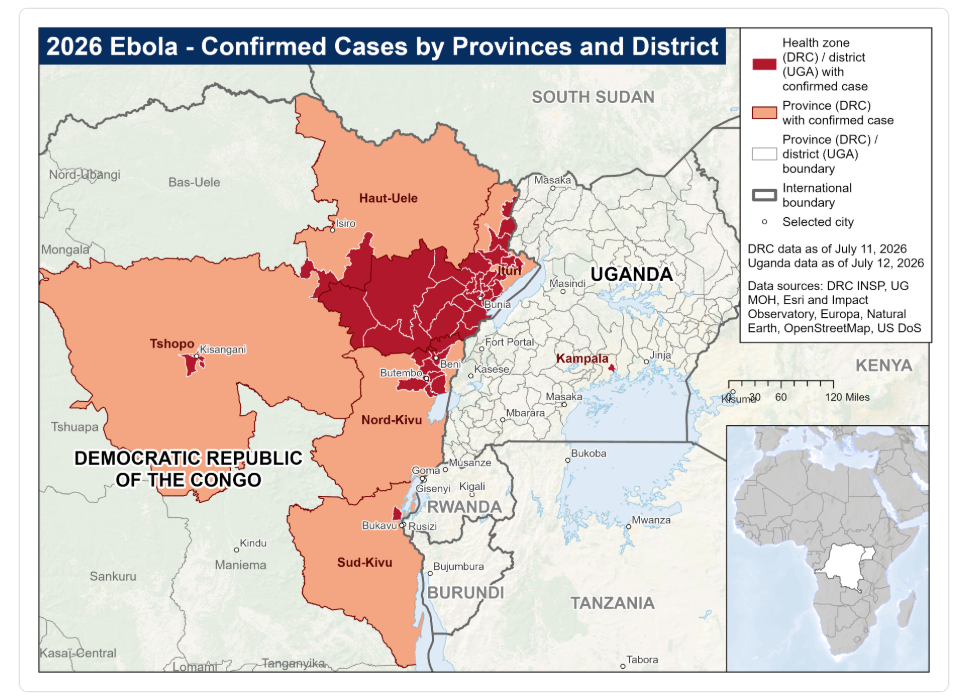
As per the latest data available (12 July) by The National Institute of Public Health DRC, there are a total of 1,926 cumulative confirmed cases across five provinces in the DRC. There are 702 cumulative deaths among confirmed cases and case fatality rates in the DRC.
The Ebola outbreak in the DRC has spread to two more northeastern provinces, Haut-Uele and Tshopo. Up until now, the outbreak has been concentrated in Ituri Province. The epicentre of the outbreak remains Ituri.
Uganda
According to WHO, the last confirmed case was reported to be identified on 21 June 2026. As of 2 July 2026, a cumulative of 20 confirmed cases including two deaths in imported cases, and one probable case who has died, have been reported. Of the confirmed cases, 15 are imported cases, while five are secondary cases among contacts and health workers with links to imported cases from the Democratic Republic of Congo. The cases have been reported in two districts, Kampala and Wakiso, both part of the Kampala Metropolitan Area.
Two American Citizens Receiving Treatment in Germany
An American doctor contracted the disease while treating patients in the DRC and was evacuated to Germany at the time to receive specialty care. A second American citizen infected with Ebola in the DRC has been transferred to Germany for care, the head of the World Health Organization has confirmed.
On 6 June 2026, WHO reassessed the risk of the outbreak of Bundibugyo virus to incorporate newly available information and the WHO Temporary Recommendations.
The risk for countries sharing land borders with countries with documented Bundibugyo virus (BVDV) detection, as per this report Democratic Republic of the Congo and Uganda, has been separated out from the risk for other countries in the African Region.
Very High Risk
The risk in the Democratic Republic of the Congo remains assessed as very high due to ongoing transmission and the continued expansion of the outbreak into new health zones, increasing the potential for further national and regional spread.
High Risk
The risk in Uganda is still assessed as high due to confirmed cross-border spread through imported cases and ongoing epidemiological links along the eastern Democratic Republic of the Congo–western Uganda corridor, historically affected by Ebola outbreaks, including Bundibugyo and Sudan virus disease outbreaks.
The risk for countries with land borders adjoining countries with documented BDBV detection, is assessed as high due to sustained population mobility linked to cross-border trade and mining activities, variation in capacities and experience of BVD response and variable levels of readiness.
Low Risk
The risk for the rest of the Africa region and at the global level is assessed as low.